.svg)


%201.svg)
%201.svg)
%201.svg)


.svg)







.avif)
.avif)
.png)





.avif)





%20Data%20to%20Me_BLOG_1080x600.avif)


.avif)


.avif)


.avif)


.avif)


Agentforce
.svg)
.svg)
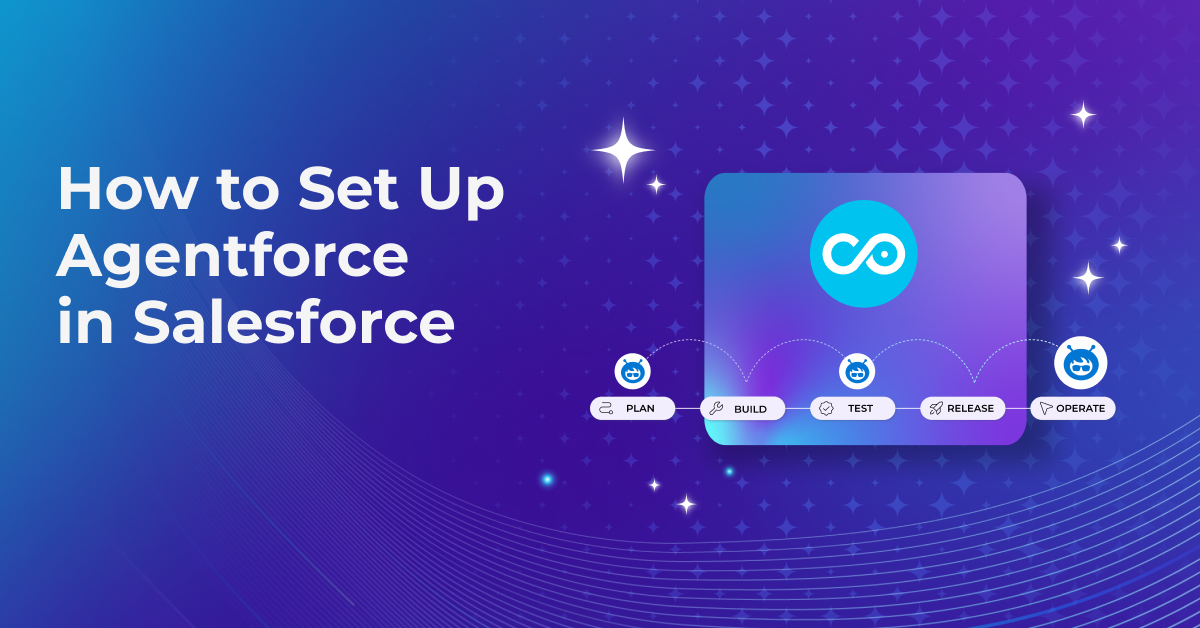
When teams first ask, 鈥淲hat is Agentforce Salesforce?,鈥� the answer usually sounds exciting: It鈥檚 AI-powered automation for smarter service experiences and faster case resolution. But then comes the real question鈥攈ow do we actually set it up the right way? The promise is big, but the configuration can feel like standing at the edge of a very technical maze.
Yet with the right preparation, a structured setup, and a deployment strategy built for control, getting started with Agentforce doesn鈥檛 have to be overwhelming. In fact, it can become one of the most powerful accelerators in your Salesforce ecosystem.
The biggest mistakes in Salesforce initiatives happen before configuration even begins. Teams jump in without reviewing licensing, org structure, or technical dependencies, so make sure you鈥檝e got the prerequisites covered first.
Agentforce solutions don鈥檛 operate in isolation. They work within your Salesforce ecosystem, and that ecosystem must be ready to support it. To successfully configure and use Agentforce, review:
Many orgs are still operating in legacy structures. If you鈥檙e transitioning from older development models, this is also the time to evaluate Salesforce source format vs metadata format.
How your org manages metadata impacts how smoothly Agentforce changes can be deployed and tracked. Metadata chaos creates release-day stress, while clean source management creates clarity. This leads to fewer surprises later on.
If prerequisites are the blueprint, environment preparation lays the foundation. The Agentforce Builder touches permissions, data access, automation, and integrations. That means your environment must be structured intentionally, not reactively.
Over-permissioning creates risk. Under-permissioning creates bottlenecks. You鈥檙e aiming for a balance of speed with control. So, ask yourself:
Once you鈥檝e got these sorted out, it鈥檚 time to apply them.
Agentforce runs on data. If your data is messy, incomplete, or inconsistently structured, automation will amplify the problem instead of solving it. This is where clarity matters, and in practice, that translates to:
Generative AI and automation are force multipliers. They multiply good systems鈥攁nd bad ones. Make sure your system falls under the right category.
Never configure directly in production. A smart sandbox strategy includes:
This is also where DevOps maturity starts to matter. Structured environments reduce risk before deployment even begins. When you prepare intentionally, you avoid errors while building confidence.
You鈥檝e assessed readiness and prepared your environment. Now it鈥檚 time to actually bring Agentforce to life inside your org. And if you鈥檙e deep in the weeds figuring out how to set up Agentforce in Salesforce, this is the stage where clarity matters most.
Start by activating required features in Setup. This typically includes:
Then, move to permission sets. Here are some best practices:
This keeps your org secure and scalable. The goal isn鈥檛 just activation, but also alignment. Every permission should connect to a business outcome.
Agentforce thrives on automation, but here鈥檚 the catch: Automation without governance becomes technical debt. It鈥檚 crucial to clearly define:
Think of automation like dominoes. If one falls incorrectly, the ripple effect can reach far beyond the original configuration. Test for:
Keep it simple, build incrementally, and validate constantly. When done well, automation becomes invisible, and it just works. That鈥檚 the goal.
Agentforce rarely operates alone. It often connects with external systems such as CRMs, service platforms, communication tools, and analytics engines. Integration setup requires:
It also helps to simulate:
Because integrations don鈥檛 fail during calm days. They fail during peak moments. It鈥檚 best to be prepared and build resilience.
You鈥檙e almost ready for deployment. This is where disciplined teams separate themselves from reactive ones. The focus should be on building certainty.
In your testing environment:
Don鈥檛 just test happy paths. Test friction.
Here are important questions to know the answer to::
This is where structured DevOps becomes essential. Without visibility, issues hide, and hidden issues surface at the worst possible time during production. It鈥檚 important to keep in mind that confidence doesn鈥檛 come from hope. It comes from validation.
Setting up Agentforce is only half the story. The real risk lives in deployment. Momentum turns into stress with manual changers, inconsistent environment, missing dependencies, and version confusion. This is why 乐播传媒app最新版本 exists.
One misaligned metadata component can cause cascading failures. And if your org is still debating Salesforce source format vs metadata format, inconsistent source management will only compound the issue.
Traditional Salesforce deployments often rely on:
But when introducing AI-driven features like Agentforce, complexity increases. You鈥檙e not just moving fields and layouts, you鈥檙e also deploying automation, integrations, permissions, and potentially AI configurations.
乐播传媒app最新版本 brings structure to what鈥檚 typically chaotic. As the only 100% Salesforce-native DevOps platform, 乐播传媒app最新版本 works where you work: inside Salesforce. It unifies planning, version control, testing, compliance, and deployment in one intelligent system.
When deploying Agentforce, 乐播传媒app最新版本 enables:
Instead of wondering whether deployment will break something, you gain:
And when Agentforce becomes part of your broader AI strategy, 乐播传媒app最新版本鈥檚 AI DevOps capabilities鈥攊ncluding Org Intelligence鈩⑩�攍earn from your metadata and delivery patterns. That means risk prediction improves over time.
乐播传媒app最新版本鈥檚 dedicated support for Agentforce is purpose-built to streamline these deployments. Meanwhile, 乐播传媒app最新版本鈥檚 AI platform demonstrates how intelligent automation removes friction across the lifecycle. Armed with these tools, deploying innovation doesn鈥檛 feel risky. It feels empowering.
Once Agentforce is live, the real work begins: optimizing performance, refining automation, and adapting to business change.
Agentforce is powerful, but even powerful tools require tuning. After production deployment:
Think of it like a high-performance engine. It runs best when monitored and adjusted regularly.
Without structured DevOps, each adjustment risks destabilizing what鈥檚 already working. With 乐播传媒app最新版本:
That鈥檚 how you continue moving fast without losing stability.
AI-driven automation impacts how people work. Make sure to provide the following for your team:
Empowered users are the real multiplier. 乐播传媒app最新版本 simply amplifies your capability to lead change confidently.
If at first you came here asking what Agentforce Salesforce is, now you know it鈥檚 more than a feature. It鈥檚 an opportunity to reimagine how service, automation, and AI work together inside your org.
If you searched how to set up Agentforce in Salesforce, you鈥檝e seen that setup requires technical readiness, structured environment, controlled configuration, rigorous testing, and intentional deployment.
The difference between a stressful rollout and a confident one isn鈥檛 just configuration skill. There鈥檚 a discipline to follow. Without structured DevOps, even well-configured systems can create chaos.
With 乐播传媒app最新版本, complexity becomes manageable. Releases become predictable, and innovation moves faster without sacrificing governance or trust.
Agentforce can transform your Salesforce ecosystem. 乐播传媒app最新版本 ensures you deliver it with confidence, clarity, and control.
Release Faster, Eliminate Risk, and Enjoy Your Work.
Try 乐播传媒app最新版本 Devops.
Explore our DevOps resource library. Level up your Salesforce DevOps skills today.


.avif)


.svg)